Sunday, October 16, 2011

Blog Assignment #6: Animation Deconstruction


I chose to use two stills from the animated movie, The Secret of Kells. The topics I’ll be comparing are color and movement. To contrast the two, the first image uses a larger variety of hues, and while there is some saturation the colors are primarily lighter. On the other hand, the second image is very dark by comparison, the background completely black. The colors are limited too; aside from the main character, teal is virtually the only color used, in varying shades and brightness. Toward the center of the second image the colors are brighter, creating the illusion of an eerie glow. As far as color goes, the two images have very little in common. The biggest thing they do have in common is that they primarily contain cool colors. For movement, both images create an illusion of movement. In the first image, Aisling’s hair appears to be blowing in the wind, and the line her hair creates is paralleled by the tree branch she is perched upon. In the second image, there is a distinct downward movement, due to Brendan’s positioning and the creature above him. The creature’s teeth are quite literally arrows pointing diagonally doward and at Brendan, drawing our attention to him and his downward descent, as well as his precarious position between the jaws of a monster. The lines behind him emphasize his movement as well, as they are parallel to his descent, yet at the same time could be seen as going in the opposite direction, drawing him straight into the creature’s mouth. The second image contains much faster, emphasized movement than the first one, and the movement in the second image is on the vertical plane, creating that sense of falling and urgency, while the first image’s movement is on the horizontal plane, creating a calmer, more balanced image. As such, the images are similar in that they both contain movement, but contrasting in that the movement contained moves in completely conflicting directions.

Blog Assignment #5: Storyboard Imitation


The first shot is aligned so that we are looking directly at the side of the 180 degree line, and the following two shots remain on the same side of it, as well as change what we see dynamically, which follows the 30 rule. First we see a side view of Tulio and the thug, then a close-up of the dice, then a top-down view of the thug as he tries and fails to make the dice change position. The fourth shot also remains on the same side of the 180 degree line with a medium shot of Miguel and Tulio. The last shot, however, is a wide shot of the main gambler and the other gamblers around him, and the camera seems to be sitting directly on top of the 180 degree line, zooming away from the gambler as the other characters on screen turn to look at the camera. The rule of thirds seems to be well implemented through all of the shots, except, again, for that last one. I suspect the director sort-of-almost broke the 180 rule and ignored the rule of thirds (centered object of focus) in order to emphasize that all of the attention is being turned on to Miguel and Tulio, who due to the previous shot we know are position directly behind the camera, across from the gambler they were dealing with. Because the shot is moving away from the gambler, it is therefore moving toward Miguel and Tulio’s position, and the fact that all the other bystanders turn to look at the camera as it moves back really focuses the attention on those two. If the shot had been placed more to the side in order to accommodate the 180 degree line, the feeling of focus on the two main characters would have been much less poignant, and the zooming out wouldn’t have fit either, as we’d end up feeling like we’re moving in a random direction rather than toward Miguel and Tulio.

Blog Assignment #4: Song Deconstruction

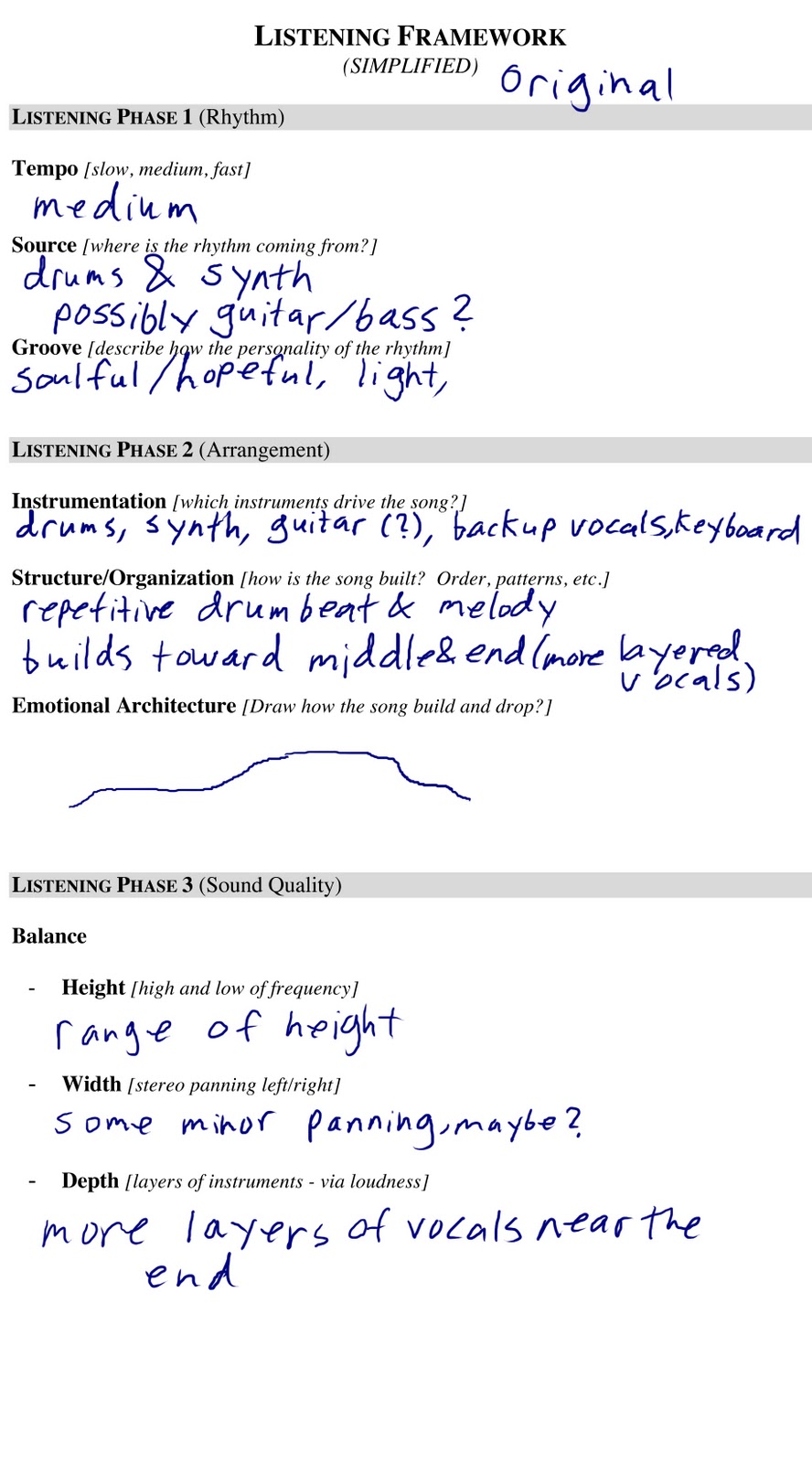
Original song:


Cover:
The song I chose was Running Up That Hill (A Deal With God) by Kate Bush, and a cover version by Placebo. To contrast the two, the original song had a much more soulful, hopeful groove, while Placebo’s version was much more relaxed. While the instruments themselves were similar, the digital effects used on them different greatly, being much more affected in Placebo’s version to make them soft and muted. Placebo’s version used recognizable piano as well, while Bush’s version used only keyboard-like or synth sounds. Bush’s version sounded like it had more depth due to a louder intensity in general, although it’s possible that both songs had a similar amount of instrument layers. As for what was similar, both songs had a similar repetitive drum beat throughout virtually the entire song, and both occasionally used chorus-like background vocals. The melody and structure were very similar as well, the main difference being the lower intensity of Placebo’s version, though the organization of the song itself was primarily the same. Overall,  Placebo’s version remains faithful to the core beat and melody of the original song, but gives it a much more soft-spoken, almost eerie feel. As for which I like better, I like both versions in their own right, but I prefer Placebo’s version. I like 80’s music just fine, but that 80’s sort of overly bright synth feel is a little too much for me sometimes. Placebo’s version doesn’t have that problem, so I could listen to it in any mood. I also enjoy the way that the slow, soft-spoken feel of Placebo’s version almost grabs your attention and makes you think about the words more than the strong, forceful vocals of the original. Kate Bush’s original version has powerful emotion in it, like a prayer directly to God, but Placebo’s feels less like a prayer and more like it’s speaking to the listeners themselves, as if to say we have the power to stand in each other’s places.

Wednesday, September 28, 2011

Blog Assignment #3: Reflections on Sound Design


(Transcript can be downloaded here. It's in HTML format because I couldn't find a way to export to PDF in Celtx.)

This scene uses a number of subtle sounds to create a certain atmosphere for the scene. The sounds were all mainly diagetic, while the music was all non-diagetic (excluding Miguel’s lute playing, as we could see when Tulio was annoyed and stopped him.) The listening mode was mainly causal, however there was at least one moment where a semantic sound was used (Tulio’s face smacking into the guard’s chestplate sounded more like metal on metal, and him “whipping” out the small dagger- it literally sounded like a whip), and one where a referential sound was used (Tulio’s landing at the end of the scene augmented with a “honk” sound.) Space is represented through the sound as well; one shot cuts to a distant angle for a couple seconds and the sounds of the duel change timbre, gaining more echo and a slight hollow sound. The gasps and cheers of the crowd maintain a relatively low intensity throughout the scene, providing a flat ambient “background” sound.  Overall, the scene doesn’t incorporate a huge abundance of sounds, but the ones used are used very effectively. You can even hear light shuffling of feet as the characters change stance or the soft crinkling of paper as Miguel gestures at Tulio with the map. Subtle, but effective.

Blog Assignment #1: Deconstructing Characters

The first character is the Hero, Chance.


Chance is represented well by the colors of fire. Fiery orange and yellow are very bright, energetic and optimistic colors, associated with ambition and happiness. He is very driven and optimistic in his pursuits, though he doesn’t always think everything through, choosing to rush toward his goals. His personality is bright and optimistic as well, though he has a one-track mind once he sets his mind to something, which goes back to his strong ambition.


For shape, the shape of this bird in flight matches up with Chance’s character. The bird has a rounded shape to it that would be even softer when not in flight, but while in flight, strong triangular shapes are created, representing Chance’s powerful ambition and single-mindedness in his goals once he’s had the chance to “fly.”


Lastly, the lone sphere in this image, surrounded by darkness aside from one singular light source, represents Chance’s situation on Earth. He is surrounded by darkness, both literal and figurative, yet he manages to keep his own “light” glowing when others around him gave up on hope long ago.

The second character is the villain, General Atiri.


The shape of the Great Pyramids represent General Atiri in many ways. The solid, triangular shape and build represent his unrelenting stance against outsiders and change, which, like the pyramids, has stood up against change for many years.


Despite being from an alien planet, the colors of (present) Earth best represent General Atiri. The natural green and blues are not present in future Earth, but are prevalent on Atiri’s planet.


Strong, natural sunlight best represents Atiri. He is not one to be shrouded in darkness, and he lives in a place where there is no pollution to block out the sun.

Monday, September 26, 2011

Blog Assignment #2: Finding Your Howl

http://changethis.com/manifesto/show/51.01.YourHowl


Flaum references a story written by a classmate in the fifth grade. The story involved a tiger in a zoo who tried to escape his cage by leaping out, but every time he leaped out of one cage he landed in another one. Flaum uses this story as an example of how life works. We live in our own personal “cages,” and though we may try to escape them by taking the clear route of jumping out, there is no escape. The only way out is to leave our comfort zone and tunnel out, and in that way find our “authentic voice.”


The lyrics of the song “I Don’t Want To Be” by Gavin DeGraw encompass a way of thinking that I have more or less lived by. In general, the song speaks of being yourself, but in a more transient sense than the clichéd idea that you should always be yourself. For instance: “I don’t want to be anything other than what I’ve been trying to be lately, all I have to do is think of me and I have peace of mind” – I’m not the kind of person who hates or dislikes myself or the way I act or look. There are times when I’m not happy with myself, but I never have to ask, ‘Who am I?’ I am who I am at this moment. It’s impossible for me to be anyone else but me, because everything I do is an action I myself chose to do. I sometimes see friends talking about how they hate themselves. I can’t hate myself, because I am me. To hate myself implies being outside myself and looking in, that the hate is a separate entity from myself, or even that my “self” is separate from me. But neither of them are. It’s all me. Everything I see and think and experience is a part of me. If I were to think I hate myself, the real target of my hate would probably have little to do with me and more with how I see myself through the eyes of society. And if I linger on how others see me enough to hate myself, then- well, just look back to this song. I can look at the world through the eyes of others, but I only need to look at myself through my own eyes.
It’s not that I think society has no effect on me. Because I am this self-aware, whenever I can, I acknowledge what societal factors have had an effect on the way I think or act. I acknowledge them and I accept them and let them be integrated into who I am here and now, and I don’t let myself be pressured into doing things that I don’t truly want for myself.
Aside from that, this song also fits well with the way I think in terms of being an atheist. I don’t need a higher entity in order to have peace of mind. I need only think of myself, and who I want to be, rather than who a higher entity(s) or their followers think I should be. That is my peace of mind.
All in all, this song speaks to me in that it reflects some of the inner thoughts and frustrations I have when faced with friends and people who have issues with themselves or with their identity. It gives me an outlet for that frustration, while also reminding me that I am not alone in this ‘enlightened’ way of perceiving myself and the world around me. It serves as a reminder for me of what’s really important to me when it comes to simply being alive. I can express myself how I want to without my thoughts being cluttered by things like ‘I hate myself’ or ‘I hate how I look’ or ‘Who am I?’ or the many other social pressures that seem to chain down and stifle so many people around me. This song describes the core of my howl.